
3 October 2026 · Brynne Lee
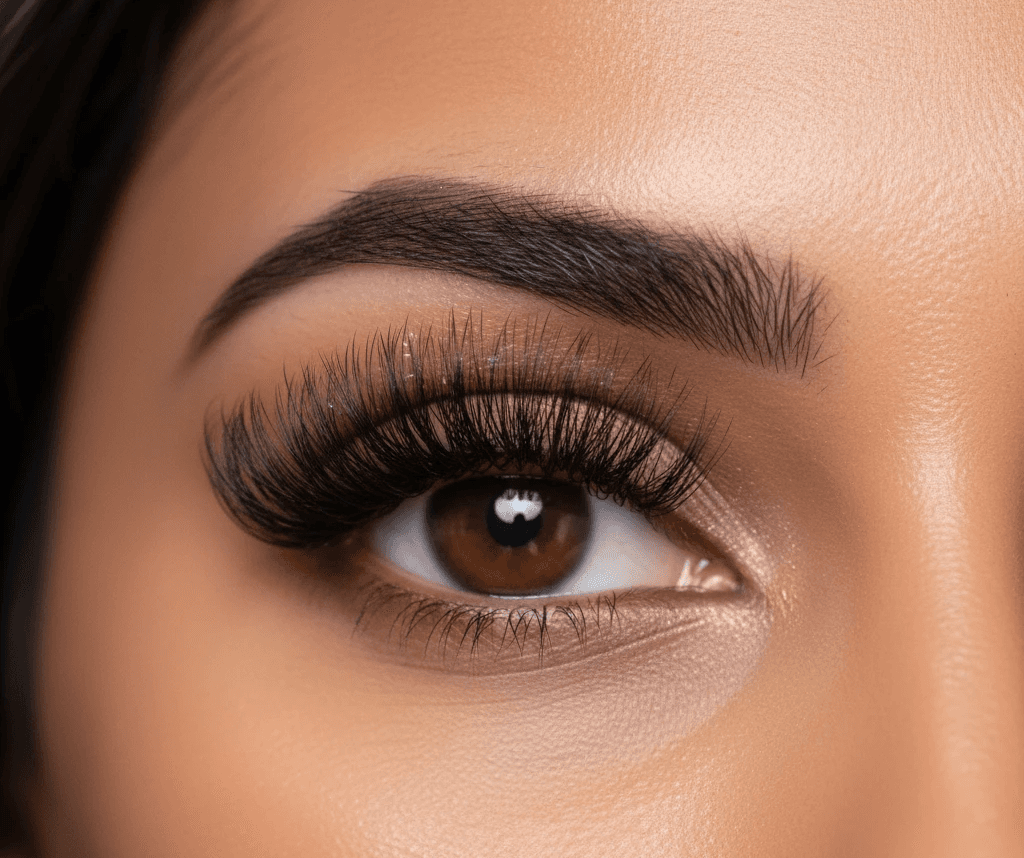
The short answer is no. An eyelash extension is bonded to one natural lash, and every natural lash falls out and is replaced. When the lash goes, the extension goes with it. The American Academy of Ophthalmology puts it in one line: extensions typically last three to four weeks, falling off as your natural lashes shed.
So anything sold as a permanent lash extension is either a set that needs regular fills like any other, or something else under that name. Here is what the word can and cannot mean.
Why no extension can be permanent
A lash is not a fixed part of your lid. It grows for four to ten weeks, stops, rests, and falls out, and the whole cycle runs four to eleven months. While it grows it gains about 0.12 to 0.14 mm a day. Every lash is at a different point of that cycle, which is why you lose a few each week without noticing and never lose them all at once.
An extension joins that cycle. Bonded to a lash that is still growing, it moves away from the lid a little every day. Bonded to a lash near the end of its life, it leaves within days. No adhesive changes this, because the adhesive is not what lets go: the lash is. Our lash science series follows one lash through its whole life in the chapter on anatomy and the growth cycle.
How long a set really lasts
With no fills, a full set thins over three to four weeks. The Canadian Association of Optometrists gives one to two months as the outer limit for the last extensions to fall. With a fill every two to three weeks, a set stays full for as long as you keep coming: grown-out extensions are removed and the new lashes that came in bare get their own.
That is what semi-permanent means on a salon menu. It describes the adhesive, not the result. At our downtown Toronto atelier a refill starts at $70 and is priced by how much of the set remains, and every full set carries a ten-day retention warranty. The arithmetic behind the fill interval is worked out in our chapter on application and retention.
What a permanent lash offer usually is
Ordinary extensions described loosely. Ask how often fills are needed. If the answer is never, the answer is wrong.
Cluster lashes: pre-made groups glued across several natural lashes at once. They hold on longer because they grip more lashes, and that is the problem: lashes that grow at different speeds are tied together. We do not apply them, and this page explains why.
A treatment that is not an extension at all, such as a lift, a tint or a growth serum.
What does last longer
A lash lift. Your own lashes are reshaped from the root so they curl upward, with nothing added to them. It lasts six to eight weeks, about one lash cycle, and there are no fills. Our lash lift is $100, or $120 with a tint.
A prescription growth treatment. Bimatoprost 0.03 percent, sold as Latisse, is authorized by Health Canada for people with too few eyelashes; it increases length, thickness and darkness. In the clinical study, half of patients saw a clear improvement by two months. It is not permanent either: when treatment stops, lash growth is expected to return gradually to where it started. The product monograph also lists a change in iris colour that is likely to be permanent, so this is a conversation for a doctor, not a salon. Our lash health chapter goes through the evidence.
An eyelash transplant. This is the only option that is permanent, and it is surgery. Under local anaesthesia, a physician grafts hairs taken from the scalp into the edge of the eyelid. The International Society of Hair Restoration Surgery is frank about the limits: the transplanted hairs keep growing like scalp hair, so they have to be trimmed and curled for the rest of your life, and the result cannot be completely natural. The possible complications it lists include infection, ingrown hairs and an eyelid that turns in or out. The procedure began as reconstruction after burns and injuries, and some doctors would keep it for that.
What to book instead
If the goal is to wake up with lashes that need nothing, two things do it honestly. A set of eyelash extensions with a fill every two to three weeks, or a lash lift every six to eight weeks if your own lashes are long enough. A free 30-minute consultation decides which suits your lashes before you commit to either.
Sources
American Academy of Ophthalmology: Eyelash extension facts and safety
Aumond and Bitton, The eyelash follicle features and anomalies: a review, Journal of Optometry, 2018
Health Canada product monograph: Latisse (bimatoprost 0.03 percent)
International Society of Hair Restoration Surgery: Eyelash transplantation, who, why and how

Brynne Lee
Lead artist, founder


Book
Thirty minutes, free, in person or on video. Returning clients book straight in: your map is on file.
10-day retention warrantyFree consultationReschedule up to 24 h before

250 Wellington St W, unit 128 · Open in Google Maps